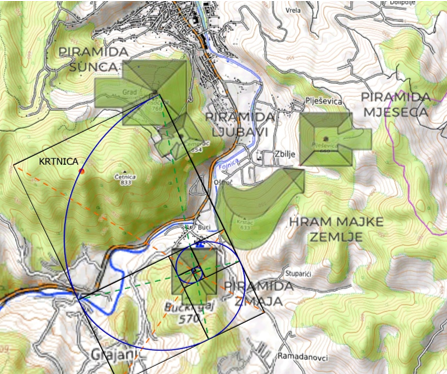
A new peer-reviewed scientific paper has been published in the International Journal of Geosciences, examining large-scale geometric patterns in the Bosnian Valley of the Pyramids.
The study, titled:
“When Landscape Becomes Geometry: Fibonacci Spiral Patterning Anchored at the Bosnian Pyramid of the Sun”
is available here:
👉 https://www.scirp.org/journal/paperinformation?paperid=149734
What Did the Researchers Study?
The research team (Osmanagich, S., Bosnia and Herzegovina; Guzzinati, M., Italy; Hoyle, R., United Kingdom) used high-resolution LiDAR scans (laser-based terrain mapping) and geodetic data to analyze the spatial arrangement of landscape features in the Bosnian Valley of the Pyramids, including pyramids and tumuli.
They asked a specific scientific question:
Do these features align in geometric patterns based on the Fibonacci spiral — or are they randomly distributed?
What Is a Fibonacci Spiral?
A Fibonacci spiral is a naturally occurring geometric pattern based on a specific growth ratio found in nature — in shells, galaxies, hurricanes, flowers, and other natural systems.
It follows a predictable logarithmic expansion pattern.
How Was the Study Conducted?
The researchers:
- Built precise mathematical spiral models.
- Anchored them to fixed landscape points.
- Tested how often such alignments would occur by chance.
- Ran Monte Carlo simulations (a statistical method used to test randomness).
In simple terms:
They used computer simulations to check whether the observed alignments are likely random or statistically unusual.
What Did They Find?
The study reports that:
- Several spiral configurations intersect multiple major landscape features.
- These alignments occur less frequently in random simulations.
- Under the tested conditions, the spatial relationships appear statistically non-random.
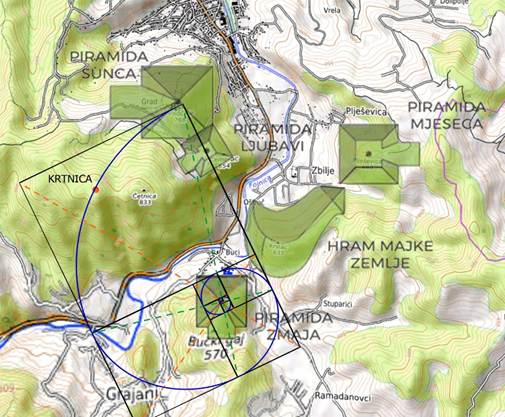
Logarithmic spiral configuration anchored at the Bosnian Pyramid of the Sun. The spiral is constructed using a fixed Fibonacci growth factor (φ ≈ 1.618) and evaluated across predefined scale bounds and rotational increments. Summit-level feature centroids (Bosnian Pyramid of the Dragon, Krtnica Hill and Bosnian Pyramid of the Sun) are plotted in projected Gauss–Krüger coordinates. Intersections are defined as points whose orthogonal distance to the continuous parametric spiral curve does not exceed the uniform positional tolerance (±20 m)
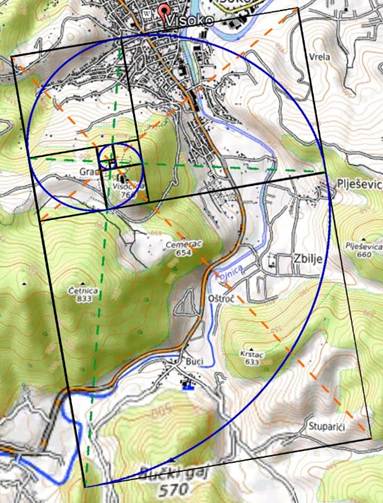
Logarithmic spiral model anchored at the Bosnian Pyramid of the Sun. The spiral is constructed using a fixed Fibonacci growth factor (φ ≈ 1.618) and predefined scale bounds. Intersections (Temple of the Mother Earth, Bosnian Pyramid of the Dragon, Bedem Hill) are evaluated under uniform tolerance constraints.
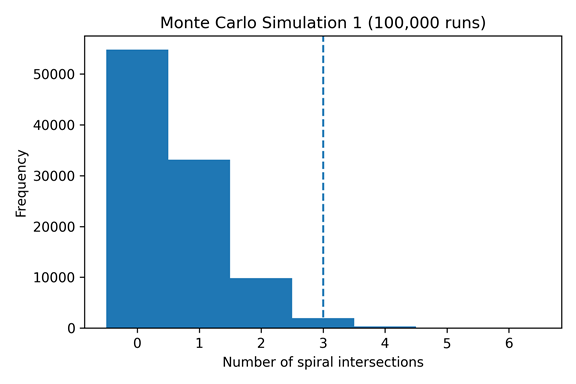
Monte Carlo simulation assessing the probability of random Fibonacci spiral intersections centered on the Bosnian Pyramid of the Sun. Comparison between observed spiral–feature intersection counts and the distribution obtained from Monte Carlo simulations under randomized spatial configurations. The observed value lies in the upper tail of the simulated distribution, indicating that the empirical configuration is unlikely to arise under the applied random placement model, given identical spatial boundaries and point counts