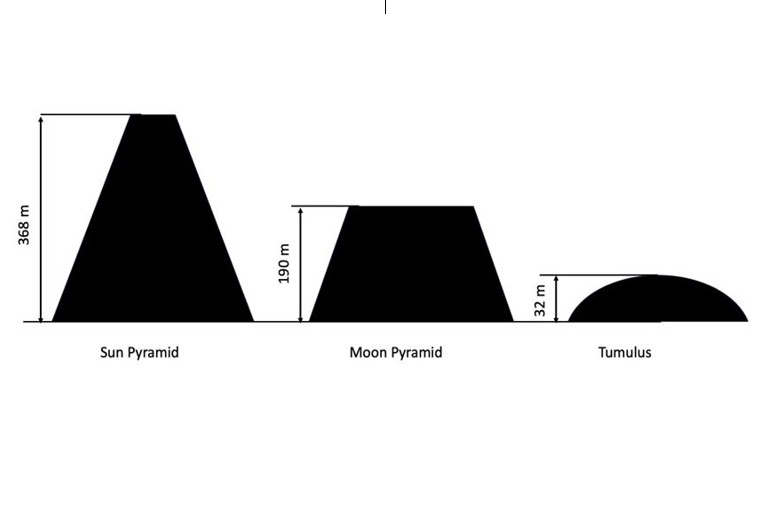
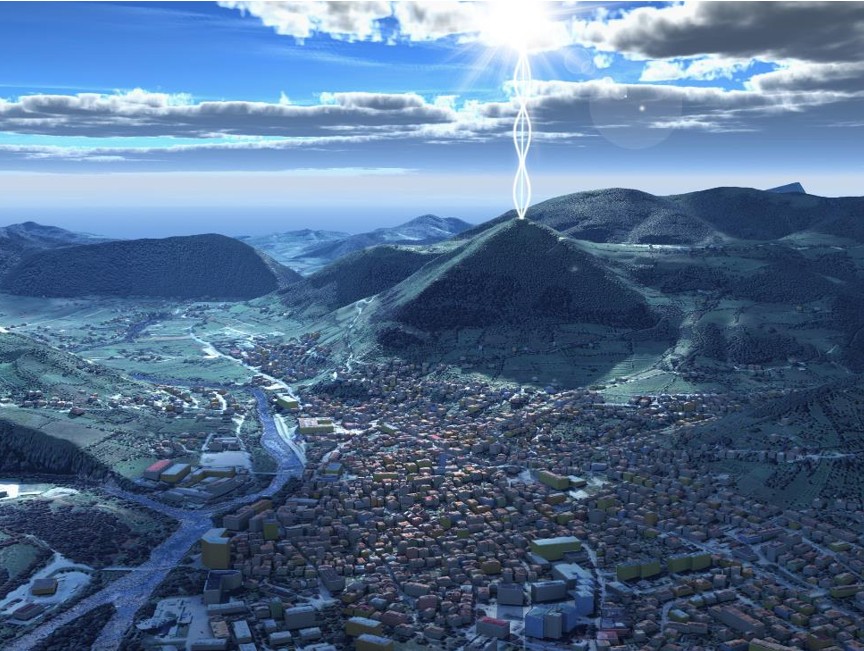
From the geological/archaeological site near Ginje, which consists of a hill and a smaller tumulus in the valley next to it, the Pyramid of the Sun can be seen between the two hills on the Northern horizon. Within the study of sacred landscapes, this is an important feature that has been identified in several European cultures. As such, it is likely that this line of sight is intentional, and part of the sacred landscape of the Bosnian Valley of the Pyramids.
Philip Coppens
Vincent Scully, a Yale University architectural historian, researched the sacred landscape of Crete and came to the following conclusions: all Minoan palaces were situated in an enclosed valley. There was a mounded or conical hill to the north or south of the palace and on its axis, a higher mountain with a cleft summit or double-peak, further away on that axis. In fact, Scully’s observations have since been found elsewhere in many cultures, including the European holy places, although, with variations. The themes are there, but the interplay of the various features is sometimes slightly different.
In short, the template is that a prominent mountain of specific shape is located on the Northern horizon. The emphasis on the Northern sky is important as the Northern polar stars have been described in many mythologies as the everlasting stars. They were linked with the Afterlife and hence the destination of the soul’s voyage upon dead. In many mythologies, the opening between twin-peaked mountains was seen to be the passage through which the souls of the deceased would enter the Afterlife. Furthermore, variations of this template can be found in Egypt, e.g. the peak of al-Qurn, known to the Ancient Egyptians as ‘ta dehent’, or ‘The Peak’, which not only has a pyramid shaped appearance but also dominates the Valley of the Kings – the royal necropolis of the Middle Kingdom.
North was linked to the World of the Dead. In some cultures, the sacred mountain to the north was sometimes called "The Storehouse of the Dead" and it should be underlined that when looking from Ginje, this "Storehouse of the Dead" is no other structure than the Pyramid of the Sun, above which the "Everlasting Stars" could be seen to circle.
Paul Devereux carried out further detailed research on the sacred landscapes in 1992 (The Symbolic Landscapes). In his book, Devereux relates how mythology and the landscape interact, e.g. the so-called Song Lines of the Australian Aboriginals. Devereux repeats that Scully observed (in the Earth, the Temple and the Gods) that there was an interaction between the temple and the surrounding landscape, something he noted in Crete and elsewhere in Greece as well. To quote Devereux on Scully: "He felt that the ancient Greeks had developed an eye for the specific combinations of landscape features as expressive of particular holiness."
Scully devoted much attention to Crete but it is on the Greek mainland – and hence not too far from Visoko – that we find direct correspondences with Visoko, especially with Mount Zara and the site of Mycenae, one of the ancient Greek most important citadels. As Devereux describes it, Mount Zara appears in almost pyramidal form when seen from the palace (on the summit of the citadel). Devereux noted that Mount Zara and Mount Marta together, echoed the Mycenaean terracotta figures with upraised arms. He adds: "Scully felt that the cone shape was more important in Mycenae than in Crete as it echoed further in the tholos tombs of the early Mycenaeans, which were bell-shaped stone chambers within earthen mounds".
Noting that one of the two sites in this location has all the appearances of a tumulus, it is likely that it contained (contains) a burial. Some of the monumental stone blocks found in this area, especially the hill above, suggests a structure – a temple – which might, by analogy to other sites in Europe and nearby Greece, be aligned to the Pyramid of the Sun.
That the sightline from these structures towards the Pyramid of the Sun is not accidental is underlined by research carried by Nenad Djurdjevic. He highlights that from this tumulus (only a few meters high), one may clearly observe the profile of the Pyramid of the Sun. But standing in front of its base, the Pyramid of the Sun is not visible. It suggests that the tumulus was specifically constructed here and raised to such height that made a sightline to the Pyramid of the Sun visible.
Within the context of sacred landscapes, the complex at Ginje has therefore revealed several key components during the initial analysis that strongly suggests that the site itself was a part of the sacred ancient landscape, focusing on the Pyramid of the Sun. It means that the Bosnian Valley of the Pyramids is therefore not only more extensive than previously thought but is equally more than likely a carefully constructed landscape, as initial observations (e.g. equidistance between the Pyramids of the Sun, Moon and Dragon) have already indicated.