As a graduate student at Oxford, Jonathan Rider is deeply rooted in the formal methodologies of archaeology, which he sought to practice here for his volunteer period of the past three weeks. However, growing up in Wiltshire, England, in the shadow of Stonehenge, Mr. Rider has also always been cognizant of the unknown, the mysterious.
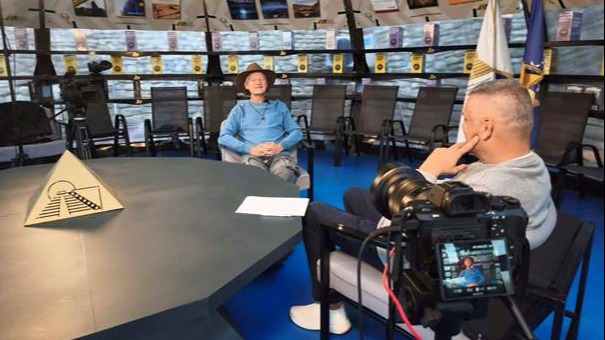
 Interview – Ed Weinberg
As a graduate student at Oxford, Jonathan Rider is deeply rooted in the formal methodologies of archaeology, which he sought to practice here for his volunteer period of the past three weeks. However, growing up in Wiltshire, England, in the shadow of Stonehenge, Mr. Rider has also always been cognizant of the unknown, the mysterious.
He has done a couple of intensive archaeological projects like this one before, including one in Peru of a particularly relevent interest. He spent a month at a site called Cahuachi, containing, what else, pyramids. As I quiz him on this subject, I begin to see some parallels.
“We were working on this big village or city, there was lots to find, dead bodies everywhere, material, pottery, walls, floors.
“From the little I understood, I was the only English-speaker there, from what I understood from my Spanish, these things were huge step pyramids, entirely artificial, not hills that were sculpted in any way, these were built from scratch. There was a lot of material associated with it, a hell of a lot, both on the pyramids and at the bottom. During construction they would bury pottery, they would break pottery and put it into the walls, there would be trophy heads, severed heads, all sorts of things incorporated into the actual construction of the pyramids. On the top of the pyramid, I think they found mummified babies and mummified parrots as well. “This was under a foot or two of sand, tons and tons, right in the middle of the desert. You just scrape away the top soil and very quickly you find this settlement, this big city in fact. Not gonna remember the date, but it’s very old, it’s pre-Inca. One of the first big civilizations in Peru anyway. “I know it’s been going on since the ‘80s, it’s a twenty-year project, there is so much there. I know that it will go on for at least another ten years or so. Every hill you see in the area is pretty much a pyramid.”
Mr. Rider feels it would be brash to compare to compare a project so new with one in its third decade. “Obviously, there’s something very interesting here. There needs to be a lot more work done.”
I ask him what he did in his short time here. “The main work we’ve been doing is helping Alexander [Cartwright, fellow Oxford archaeology student] clear away a couple of trenches, just to find layers of either floor or natural soil, we don’t know which. And that’s really been it. I’ve been asked to identify a couple of stones. Had a couple of interviews on TV, which I,” he flashes a wining smile, “I hope I never see.
“We had a chance to open up a couple of our own trenches up on the plateau as well. We didn’t really find anything other than the edge of a path, I think. And then they started clearing mines.”
Some artifacts were found, but Rider dismisses them. “We found some pottery, but it wasn’t very old. I should think a couple of hundred years at the max.”
I ask him about the future of the project, and he is more effusive. “There is huge potential here obviously. This is a massive project. From the stuff I’ve seen here, I would say, there seems to be some kind of large-scale human structure.
“Certainly there’s something very interesting, archaeologically-speaking here.”