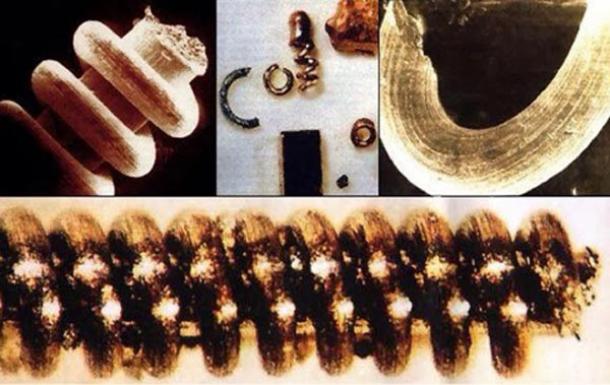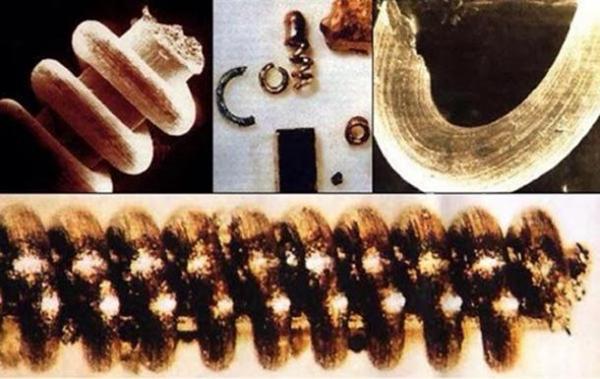
An Oopart (out of place artifact) is a term applied to dozens of prehistoric objects found in various places around the world that, given their level of technology, are completely at odds with their determined age based on physical, chemical, and/or geological evidence. Ooparts often are frustrating to conventional scientists and a delight to adventurous investigators and individuals interested in alternative scientific theories. In 1991, the appearance of extremely tiny, coil-shaped artifacts found near the banks of Russia’s Kozhim, Narada, and Balbanyu rivers brought about a debate that has continued to this day. These mysterious and minuscule structures suggest that there may have been a culture capable of developing nanotechnology 300,000 years ago. These manufactured coils were initially discovered during geological research associated with the extraction of gold in the Ural mountains. These pieces include coils, spirals, shafts, and other unidentified components.
According to an analysis from the Russian Academy of Sciences in Syktyvkar, the largest pieces found are mostly copper, while the smallest are made of tungsten and molybdenum. While the largest of these objects measure 1.18 inches, the smallest are only 1/10,000th of an inch, and many exhibit Golden Mean proportions. Their shape suggests that they are manufactured and not naturally occurring metal fragments. In fact, they have been found to closely resemble the same miniature components of contemporary nanotechnology.
Though some have asserted that these tiny structures are merely debris left behind from test rockets being launched from nearby Plesetsk space station, a report from the Moscow Institute determined that they are far too old to have come from modern manufacturing.
In 1996, Dr. E.W. Matvejeva, from the Central Scientific Research Department of Geology and Exploitation of Precious Metals in Moscow, writes that, despite being thousands of years old, the components are of a technological origin.
The pieces were found at a depth between 10 and 40 feet, in a geological stratus between 20,000 and 318,000 years old.
How were humans able to manufacture such tiny components in the distant past, and what were they used for? Some believe that the coils prove the human race enjoyed a sophisticated level of technology in the Pleistocene era, while others assert that the findings are the work of extra-terrestrials.
The artifacts have been studied at four different facilities in Helsinki, St. Petersburg, and Moscow. However, further research into these tiny structures seems to have ended in 1999 with the death of Dr. Johannes Fiebag, a principal researcher of the find.
The article ‘Russia’s ancient nanostructures’ was originally published on The Epoch Times and has been republished with permission.
Featured image: The nano spirals found in the Ural Mountains. Image source.
Gallery