In recent weeks, we received a series of intriguing session transcripts from researchers Petteri Viitanen and his colleague Antti, who have been conducting independent intuitive explorations. These sessions, originally recorded in Finnish and carefully translated into English, offer a unique and open-minded perspective on the Bosnian Valley of the Pyramids and its possible role within a broader planetary and cosmic framework.
We are sharing some of the key themes from these readings, not as definitive conclusions, but as thought-provoking material that may complement ongoing scientific and archaeological research.
You can read the full session transcripts here:
Different Traditions: Bosnia and Giza
One of the central ideas emerging from these sessions is the distinction between the Bosnian pyramids and the pyramids of Giza. According to the readings, while pyramids existed across the planet and may have been interconnected through energetic “lines,” the Bosnian pyramids are described as belonging to a different tradition, with a distinct energetic orientation.
Giza is portrayed as a central hub, with energy directed outward and upward — toward the stars — while the Bosnian pyramids are described as having a stronger downward connection, linking to deeper layers of the Earth. This concept suggests a complementary relationship rather than competition between different pyramid sites.
Geometry, Fibonacci and Energy Flow
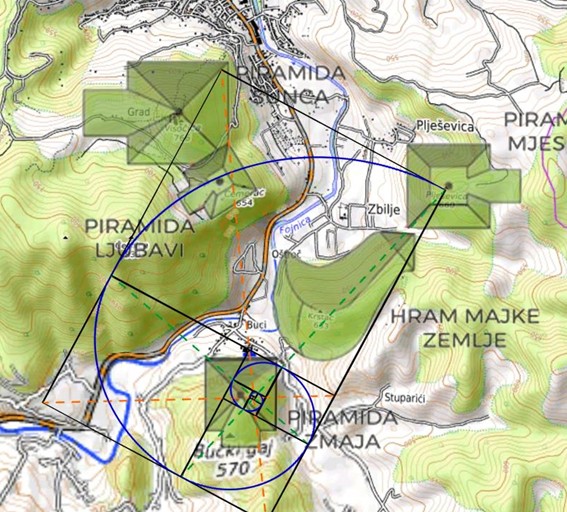
A particularly compelling aspect of the sessions is the emphasis on geometry — especially the presence of Fibonacci spiral patterns. The Bosnian Pyramid of the Sun is described as generating a spiral-like energy wave rising from its apex, surrounding a central vertical axis.
This spiral is portrayed not only as a structural feature but as a functional one — facilitating both energy flow and information exchange. The idea of a two-way connection, extending both upward and downward, reflects a model in which pyramids serve as dynamic interfaces between different layers of reality.
Interestingly, this resonates with certain measured phenomena in the Bosnian Valley, including focused energy beams and precise geometric relationships, which continue to be studied.
Connection to a Larger Cosmic Network
The sessions also introduce the concept of a “central sun” — described metaphorically as a hub or intersection point for information and energy exchange across planetary and stellar systems. In this view, the Bosnian Pyramid of the Sun functions as a node within a much larger network, linking Earth to broader cosmic processes.
While such ideas remain outside the scope of conventional science, they reflect a recurring theme found across many ancient traditions: that monumental structures may have served purposes beyond the purely architectural.
Deep Antiquity and Lost Civilizations
Another dimension explored in the sessions relates to timelines and civilizations far older than those currently accepted. References are made to advanced societies and construction efforts tens of thousands — and even hundreds of thousands — of years ago.
These perspectives challenge mainstream historical frameworks, but they also echo a growing recognition that much of Earth’s past may still lie undiscovered, buried beneath layers of time.
A Complementary Perspective
It is important to emphasize that these session-based insights are not presented as scientific proof. Rather, they offer an alternative lens — one that can inspire new questions, new hypotheses, and potentially new directions for research.
At the Bosnian Valley of the Pyramids, our work continues to be grounded in multidisciplinary scientific investigation: archaeology, geology, engineering, and energy measurements. At the same time, we remain open to exploring broader interpretations that may help us better understand the purpose and significance of these remarkable structures.
Looking Forward
As research continues, both in Bosnia and around the world, it is becoming increasingly clear that the story of ancient civilizations is far from complete. Whether through excavation, measurement, or new forms of inquiry, the coming years may bring discoveries that reshape our understanding of humanity’s past.
These sessions represent one such contribution — an invitation to look deeper, think wider, and remain open to the possibility that ancient knowledge may have operated on levels we are only beginning to rediscover.
We thank Petteri Viitanen and Antti for sharing their work and contributing to this ongoing exploration.