In the high desert west of Burns, Oregon, a team of archeologists have discovered an unusual artifact they suspect is new evidence of one of the oldest human settlements in North America.
The discovery has yet to be published in a peer reviewed scientific journal, but if it is, it will add to the mounting body of evidence that suggests humans arrived in the Americas earlier than archeologists once thought.
The discovery is a small, beautiful knife carved out of a clear orange agate. One side has a number of serrated points, like a saw. The other edge has a steep, flaked edge that could have been used to scrape hides and cut meat off of bones.
Bureau of Land Management Oregon
“Its kind of a neat little artifact, the prehistoric version of a Swiss Army knife,” says Scott Thomas, an archeologist for the Bureau of Land Management.
Thomas believes the knife was made more than 15,000 years ago. He’s part of a team, led by Dr. Patrick O’Grady at the University of Oregon, that is excavating an ancient human camp sheltered by a rock overhang along a now-dry stream in Eastern Oregon.

Bureau of Land Management Oregon
The team has found many signs of human occupants, including dozens of stone points and an old fireplace, but it has just started exploring the oldest layers of the site.
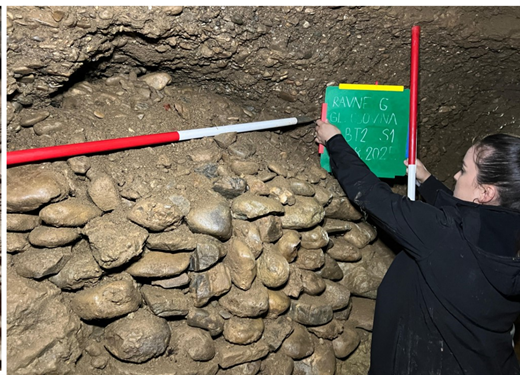
In the fall of 2012, a seasonal excavator named Chuck Morelan struck a bit of luck. Morelan was tasked with excavating a small area all the way down to the bedrock, to see how deep the site extended. About 10 feet down, he discovered a thick layer of volcanic ash. A little further down, he found fragments of animal teeth, and the striking orange knife.
Thomas, who was working alongside Morelan, says the knife struck him as a little mysterious. The site is littered with obsidian, and yet it was carved out of agate, a rarity in the Oregon high desert.
“I’ve been here 20 years, and I’ve seen a lot of sights, and I’ve never seen this color of an agate in any site,” he said.
The mystery of the little tool deepened when Thomas sent a sample of the volcanic ash found just above it to an expert at Washington State University for radiocarbon dating. The result: the ash came from an eruption of Mt. St Helens between 15,200 and 16,400 years ago.
“My jaw dropped. We didn’t expect it to be that old,” Thomas said. The ash effectively dates the tool and the animal teeth, which were found about 8 inches below it.

Camel Tooth Enamel Fragments
Bureau of Land Management Oregon
Dr. Patrick O’Grady, with the University of Oregon Archaeological Field School, has been directing the Rimrock Draw Rockshelter excavations since they began.
“That would make this stone tool one of the oldest artifacts in North America. Given those circumstances and the laws of stratigraphy, this object should be older than the ash,” said O’Grady.
The team hopes to find more artifacts below the layer of ash that can be analyzed and potentially build a solid case for human occupation of the site more than 15,000 years ago.
“We have this intriguing piece of evidence that says this site is among the oldest, but we still have a lot of work to do,” O’Grady said.
The team has one more clue about the knife’s origins. An analysis of protein residue found on it matched the signature of bovine blood. The team believes it likely came from an extinct bison species, bison antiquus.
Archeologists once believed that the first people to arrive in North America were from a distinct culture called the Clovis, which arrived roughly 13,000 years ago by crossing the Bering Strait during the last ice age.
In recent years, radiocarbon dating of artifacts at a handful of sites in North and South America have suggested an earlier arrival date, 15,000 years ago or before.
Another site in Oregon, Paisley Cave, is considered home to the earliest known residents of North America based on human physical evidence. In 2008, a team of archaeologists, led by Dr. Dennis Jenkins, discovered coprolites – fossilized feces – containing human DNA dated over 14,000 years old.
But little is known about who the people were who occupied these first sites, and where they came from.
Scott Thomas, the BLM archeologist, says the small number of sites more than 13,000 years old and the lack of skeletons make it difficult to draw conclusions about pre-Clovis culture.
“These theories are actually multiplying about how people got here, not getting tighter, with all these new discoveries,” Thomas said.