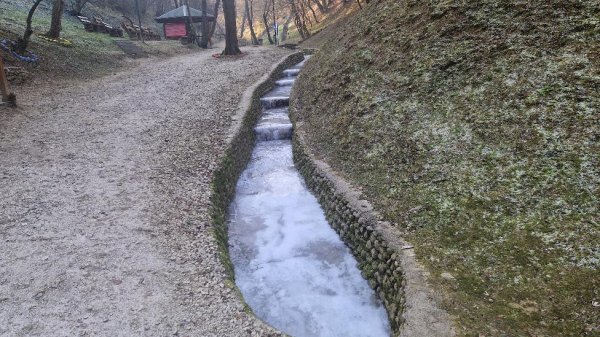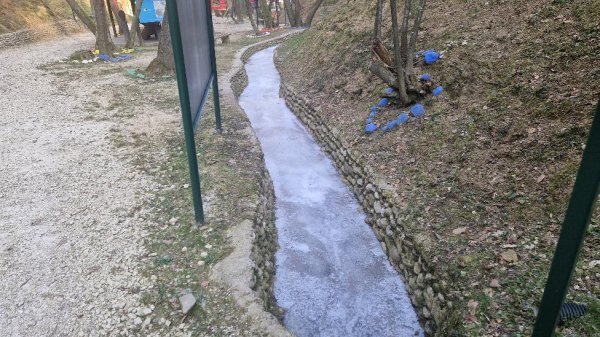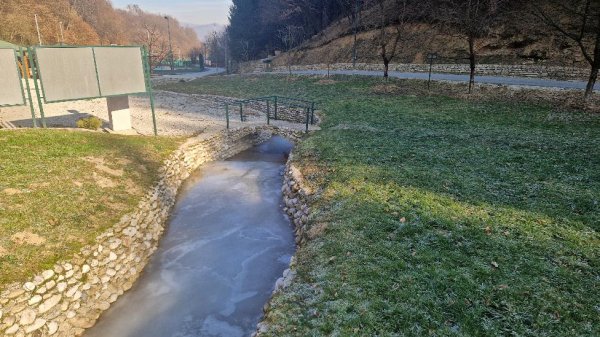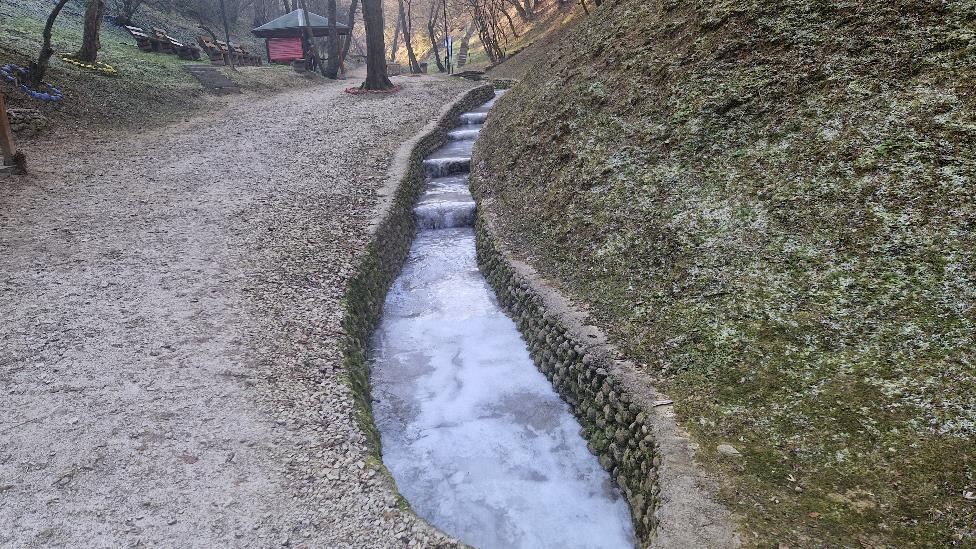
The end of December 2025 and the beginning of January 2026 brought chilly winter days. After three snowfalls in November 2025, temperatures dropped to minus ten degrees Celsius, which is entirely expected for this time of year.
On the other hand, over the past two decades, private American media—followed by most global journalistic narratives—have been speaking about “global warming,” while the Secretary-General of the United Nations has gone so far as to describe the situation as “global boiling.” The blame is placed on “humanity” and on the first two industrial revolutions and the third technological revolution. They speak of an alarming rise in carbon dioxide levels in the atmosphere.
Not so long ago, less than two decades ago, former U.S. Vice President Al Gore received the Nobel Prize for raising awareness about global warming and for claims that by 2012 the world would become a global desert, while U.S. Secretary of State John Kerry stated that “the process of global warming would become irreversible after 2014.” These predictions did not come true. Nevertheless, governments of Western countries have introduced numerous restrictions on people. For example, in the United Kingdom a regulation is in force under which most citizens are allowed to leave the country by airplane only twice a year, in order to prevent an increase in CO₂ emissions. New restrictions and bans can be expected soon.
It is a fact that temperature changes exist. Summers are indeed warmer than they were 50 or 100 years ago, and winters in our region are milder. The long-lasting snow cover that once remained for months is no longer common.
However, the planet is a living organism. As predicted by our brilliant scientist Milutin Milanković—fiercely disputed in his own environment in the Kingdom of Yugoslavia, yet accepted by the global scientific community—the planet has its own cycles and alternations of cold and warm periods. Ice ages last longer, while warm periods last approximately 8,000 to 12,000 years. Transitions between these periods are preceded by extreme temperatures.
That is precisely what we are witnessing today. Areas near the equator (for example, countries of the Middle and Near East) are experiencing record-high temperatures (Kuwait or Saudi Arabia reaching 55–60 degrees Celsius). On the other hand, record-low temperatures have been recorded in recent years in Moscow, Helsinki, and Warsaw. Contrary to the catastrophic political announcements often presented as science, ice levels in Antarctica have not decreased; instead, the winter of 2024–2025 recorded the largest ice coverage since measurements began. Unfortunately, this information rarely finds its way into biased media controlled by elites and their followers at regional and local levels.
Over the past 150 years, with all industrial development across six continents, the share of carbon dioxide in the atmosphere has increased modestly—from 0.03% to 0.04%. There is no reason for panic, but there is reason for objective observation of trends.
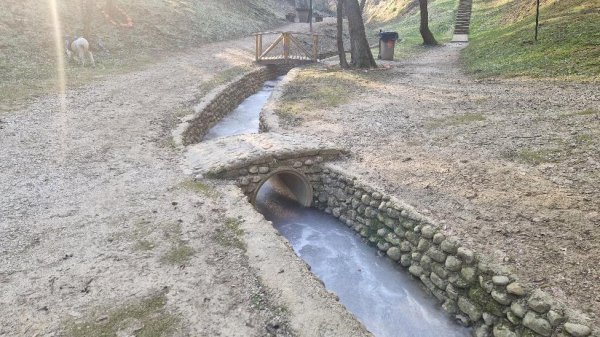
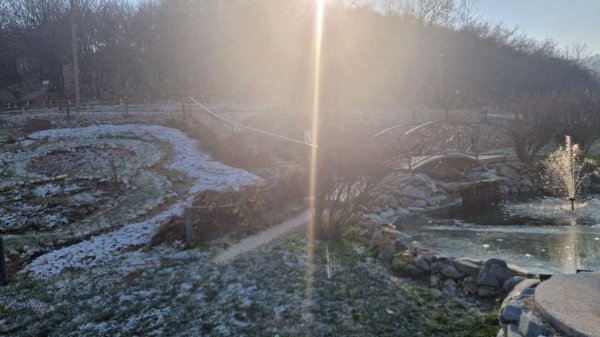
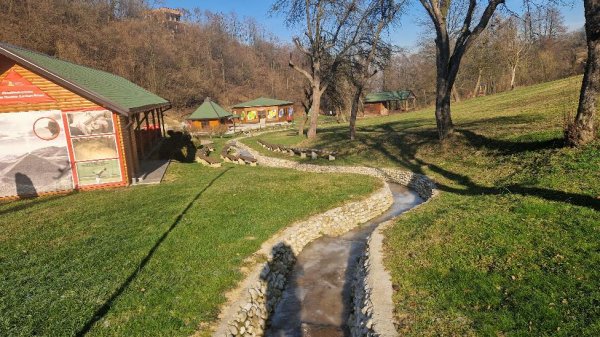
The low winter temperatures in Park “Ravne 2,” which caused water in two streams to freeze along their entire length, are a sign of normality. That is something we need now more than ever.
Gallery