The surprise discovery of traces of European ancestry in the 24,000-year-old bones of a boy unearthed in the heart of Siberia has caught the attention of Canadian experts, who say the find could rewrite the story of the people who first populated ancient Canada and the rest of the Americas.
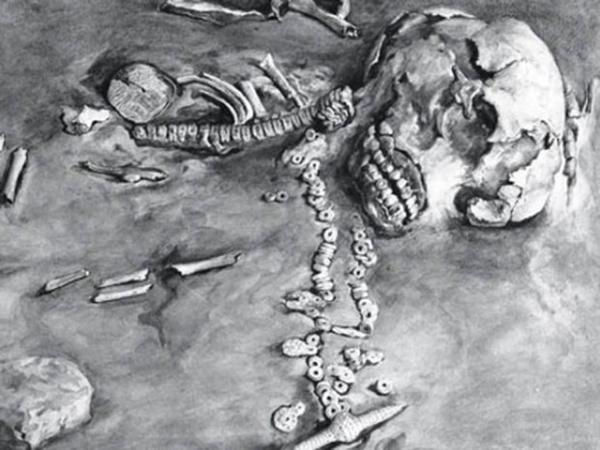
A study published in the journal Nature by a team of 31 researchers from the U.S. and Europe details how the four-year-old’s skeletal remains — excavated at the Mal’ta archeological site in south-central Siberia in the 1920s and kept since then at Russia’s Hermitage State Museum — yielded a DNA signature shared by modern European populations but also by many present-day aboriginal people in the Western Hemisphere.
The ancient boy’s DNA profile may help explain why a “European” strain of genetic material can be found among today’s New World indigenous communities, a mystery that many scientists had assumed was the result of contact in recent centuries with successive waves of colonizers from Europe.
Another controversial theory to explain the shared DNA is based on the idea that boat-using tribes of seal-hunters from ancient Europe might have migrated westward to the Americas along a North Atlantic ice edge.
But the Nature study offers another explanation: that the people who would eventually cross the so-called “Bering Land Bridge” between northeast Asia and Alaska near the end of the last ice age about 13,000 years ago had a key branch of ancestors in prehistoric Europe. Those ancient ancestors, it’s now theorized, must have moved eastward into central and then eastern Asia, mingling with other populations and eventually crossing to the Western Hemisphere when low ocean levels created a temporary land corridor between the eastern tip of Russia and the western edge of Alaska.
“The result came as a complete surprise to us,” Danish archeologist Eske Willerslev, a University of Copenhagen researcher who led the study, stated in a summary of the findings. “Who would have thought that present-day Native Americans, who we learned in school derive from East Asians, share recent evolutionary history with contemporary western Eurasians?”

Successive waves of human migration from eastern Siberia along the land-bridge route are widely presumed to be the origin of the hundreds of aboriginal nations that were spread throughout the Americas before Renaissance-era Europeans began permanently settling in the New World about 500 years ago. More than 50 million aboriginal people living today in North, Central and South America are believed to be descendants of those initial, bridge-crossing inhabitants of the New World.
The study’s findings are significant for “suggesting a huge percentage of the genome of Siberian people during the Ice Age is actually coming from Western Europe,” said Grant Zazula, a Yukon government paleontologist who has studied the relationship between mammoths and humans in ancient “Beringia” — the glacier-free grassland that covered parts of Alaska, Yukon and Siberia more than 10,000 years ago.
[It’s] indicating some degree of relatedness – a significant degree of relatedness – to First Nations populations in the New World, which had not been anticipated. So it’s quite significant
“If you look at the genomes of modern Native American people, South American native people and Canadian First Nations people, there’s a chunk of that genome that looks European – or is European,” said Zazula. “It’s often thought that was a result of modern mixing of populations” in relatively recent times, he said, but the new study suggests a significant portion of the genetic heritage of the New World’s first inhabitants was “ancestrally coming from the Ice Age in Western Europe.”
About 25,000 years ago, he said, “a group of people in Western Europe that started moving east, mixed with some people in central Siberia, and those people kept on going east and mixed with some east Asian people — maybe (from geographical) China, Korea, northern Japanese — and then eventually crossed the land bridge.”
University of Alberta archeologist Jack Ives also highlighted that the “Mal’ta Boy” DNA profile “is indicating some degree of relatedness – a significant degree of relatedness – to First Nations populations in the New World, which had not been anticipated. So it’s quite significant.”
Ives added that the importance of the finding is enhanced by the scarceness of evidence from a period so deep in human history: “In much of Siberia, as in much of the New World, human remains from this particular time interval are extremely rare.”
Ives recently led a team of Canadian researchers who shed new light on the complicated way early New World peoples moved through the so-called “ice-free corridor” east of the Rocky Mountains, an important conduit for populations migrating into the interior of North America as the glaciers retreated at the end of the last Ice Age.
He said the Siberian findings reinforce the links between seemingly disparate human populations.
“On one primary level, it continues to tell us – if we could just take it into account more often – we’re all fairly closely related, and that European populations and First Nations populations may share more genetic heritage than we previously thought. It’s worth keeping in mind in the modern world.”