In 2005, the story broke that the small town of Visoko, just outside the Bosnian capital of Sarajevo, potentially had a pyramid. During Sam Osmanagic’s promotional lecture tour for his book on Mayan pyramids, the director of the Visoko Historic Heritage museum, Senad Hodovic, invited him to look at an enigmatic mountain that loomed over the historic town.
In 2005, the story broke that the small town of Visoko, just outside the Bosnian capital of Sarajevo, potentially had a pyramid. During Sam Osmanagic’s promotional lecture tour for his book on Mayan pyramids, the director of the Visoko Historic Heritage museum, Senad Hodovic, invited him to look at an enigmatic mountain that loomed over the historic town. He – and anyone else who sees this mountain – agreed it looked like a pyramid. So why did no-one suggest it was a pyramid? Because if it was a man-made pyramid, it was one of the biggest pyramids ever constructed.
The Pyramid of the Sun
Preliminary exploration work was carried out that same year, using geologist Nadja Nukic. She was puzzled by three layers of brown polished stone that were positioned at equal distances from each other and suggested further exploration was undertaken.
Early excavation work began in 2006, amidst press conferences and the world media’s attention; academics, alternative writers and local and other tourists came to visit too. Unsurprisingly, controversy broke out, with some arguing that the pyramid was 12,000 years old, and some arguing it was a freak of nature. Controversy once again reigned in piramidology.
Today, the “Pyramid of the Sun Foundation” is in its second year of excavation; it have been rough times. In a country that is slowly beginning to forget the horrors of a brutal and sudden civil war, in a country where people of various religions once again begin to work together, a new ingredient has been thrown into the equation: a valley, just outside of the capital, that has not one, but several potential man-made structures.
The first – obvious – target for excavation was the mountain above Visoko, which was soon nicknamed “Pyramid of the Sun” – which is now also the official name of the foundation that runs the excavations.
The structure does not merely look man-made, at 220 metres high, it has four equal-sized bases of 365 metres each. Each side is furthermore perfectly aligned to the cardinal points. It is much larger than the Great Pyramid and if manmade, would be the largest pyramid on Earth.
 Pyramid of the Moon
On first impression, the hill seems to be a mixture between the much smaller Chinese pyramids and the Mexican pyramid of Cholula. Osmanagic too felt that the site resembled Cholula; but rather than a church on top, Visoko, a place-name that means “the high town”, was actually named after the first location of the town: on the very top of the mountain/pyramid. And the meagre ruins of this medieval town were used as the first hammer to strike the team with.
When the excavation project was announced, 21 experts from different towns signed a petition to stop the excavations at the Pyramid of the Sun, arguing that the medieval town of Visoki was in danger because of the excavations. Read: why were “amateurs” put in charge of something academics felt was solely their bailiwick. Their “plea” was heard by Western archaeologists who decided to enter the debate, for there was a rumour that Osmanagic had claimed that the pyramid was 12,000 years old. Some, including Anthony Harding, seemed to feel such delusions had to be stopped, at all cost.
Today, two camps exist, largely waging battle on the internet. The first camp consists of critics who use every element that goes against the man-made possibility as further proof that it is all a hoax. Most have never visited the sites, or did so very quickly. The other camp vociferously attacks those speaking out against the pyramids, largely underlining the credentials of those experts that speak out in favour of the man-made nature of the structures.
The group of anti-pyramid opponents, like Blagoje Govedarica, Zilka Kujundzic, Svetozar Pudaric, Mirko Babic, Gavrilo Grahovac, Ivan and Dubravko Lovrenovic, are working hard to debunk the pyramid research project, arguing that the entire endeavour is about putting Bosnia on the map; they argue it’s the Muslim answer to Medjugorje, a site where the Virgin Mary allegedly appeared and which is now a major tourist magnet. They argue Visoko has now become a local tourist trap, based on a lie, or rather, a hallucination.
As a consequence, Visoko has become the modern Glozel and Osmanagic the new Emile Fradin. One American historian working for the foundation states how the vitriolic attacks from the archaeological and geological communities have taken her by surprise. And the problem is larger than just that establishment: there are also politicians in the mix, each of whom wants some form of notoriety, no matter what, or how.
 2006 excavations on northern face of Pyramid of the Sun
On approach to Visoko, it is hard to believe that it took until 2005 before someone seriously pondered the notion that the hill could be a pyramid. The bottom of the hill has been built upon and the streets are more than steep. Early on, Osmanagic was told that several of these homes wanted, but could not have, a cellar, because of a cement-like layer hiding approximately one metre below the surface.
Not far up the "mountain", you park and begin a steep series of sandy mixed with gravel steps, of recent addition, to allow visitors to see the site that was explored in 2006. The incline, from the streets of Visoko to here, is a staggering sixty degrees – and continues to the very top of this flat-topped pyramid.
The excavation site (about one third up the hill) has revealed large blocks of stone and looks relatively unimpressive. The “blocks” are a mixture of small stones that were sculpted by water, held together by sand/cement. Similar excavations have occurred on the other sides of the pyramid; in each case, just below the surface, a layer of this cement has been found.
When geologists studied this site, some labelled it natural, some artificial. Fair enough. But today, the site is no longer an isolated occurrence. Further to the right, the layer of earth that has covered this “cement” – which some see as the original coating of the pyramid – has been removed. Here, you can walk about 20 metres upwards, on the sixty degrees slope, noting how wherever the team dug, this cement layer was present just below ground level; though it is obviously very old, it is perhaps best described as if someone fifty years ago has put a cement road here, now in need of repairs.
 In 2007, a limited amount of work has been carried out at the Pyramid of the Sun. One site where work is ni progress, is the so-called “Pyramid of the Moon”, on the other side of the river Bosna, the river that runs through Visoko. “Only” 190 metres high, and situated lower in the valley, the foot of this pyramid has become a second showcase of the foundation’s work. Excavations have shown a type of “floor” lying on sandstone, followed by a second layer, in approximately one metre high steps.
Nearby, the team wanted to probe where two faces of the pyramid would meet and found a stone structure, which looks like a well. It is but one fortuitous discovery in a series of findings.
2006 excavations on the Pyramid of the Moon
Much harder to reach is the excavation at the top of the pyramid, where stretches of earth have once again been moved aside to uncover what lies beneath – like the Pyramid of the Sun, at a depth of roughly one metre.
This site is typical of how discoveries have been made: local people, when they heard that peple were testing to see whether these mountains were artificial, came to talk to the team members (several of the workforce are local too), talking about locations where they and/or others had taken or found enigmatic stones or formations. In this case, the landlord was trying to dig a well, but after less than a metre, stumbled upon enigmatic rocks – quite similar to the “flooring” found at the bottom of the pyramid. Since, the excavation team has made the well much deeper, in an effort to see whether something is hiding below. Work, of course, is arduous and progress is slow.
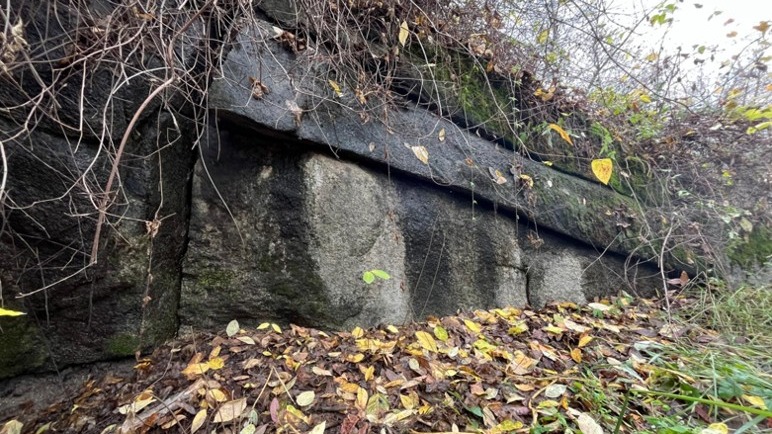
Nearby, top soil has also been removed and below, the same type of flooring has been discovered. Archaeologists are showing how you have a layer of top soil, and below natural layers of sandstone; but separating both is a thin layer of rectangular stone blocks that look, in size, similar to modern paving slabs. In substance, they look as if they have been poured, and laid side by side. Interestingly, some are broken, but these fractures are always random; their “original shape” is always rectangular.
Locals pointing out anomalies is also what brought the team to Gornja Vratnica, some four kilometres from the pyramid site and situated in a different valley. This is not a pyramid; it is a stone shrine, situated on top of a small hill known as Toprakalia, named after the Turkish soldier whose grave sits on top. That the team take great care in their work is on display here, with his tomb carefully marked as off-limits.
When team members came here to carry out an initial survey, it was found that the magnetic north seemed to move on a daily basis. The first excavation on one side of the mountain seems natural. However, the team then moved slightly upward, and this time found a layer of massive stone blocks, some weighing in at 20 tonnes, which look anything but natural. They are rectangular, and positioned side by side. The best comparison is probably with the huge building blocks used by the ancient Egyptians for their temple – and pyramid – construction.
As elsewhere, there are nevertheless several “layers” of stone floors below and above. One level has small openings between the blocks (a few centimetres wide) that lead inside the hill. One member of the team explains how one morning, he used to blow cigarette smoke into the opening, to see what would happen. About an hour later, working nearby, he observed that it seemed as if the pyramid was breathing out that smoke. So he repeated his little experiment, with the same result. But, he says, it only seems to work in the morning. It is but one reason why the team plan on continuing to penetrate deeper into the hill, in search of hidden cavities.
 The team have identified other potential sites of interest in the valley. One is the Pyramid of the Dragon, which together with that of the Moon and the Sun makes an almost perfect triangle, which each side ca. 2200 metres long. No work has been carried out on this third potential pyramid, nor on the “Temple of Earth”, situated on the line between the Pyramid of the Dragon and the Moon or the “Pyramid of Love”, between the Sun and the Moon Pyramid, though not on their connecting line. For the 2007 season, the entire team consisted of sixty people. It is small – too small – to cover the enormous area that needs to be covered. Hundreds more are required for the excavation project to make faster progress.
When the excavation of the Great Pyramid started, dynamite was the explorers' favourite technique to penetrate into the dark and mysterious interior of this artificial stone mountain as fast as possible. Visoko’s pyramids have tunnels too; several, but no dynamite is used here. Again, when stories about tunnels that seemed to lead into, or at least in the direction of, one or more pyramids, were heard, one local noted that when he constructed his factory, right next to the river, six tunnel entrances were filled in with cement. Some tunnel entrances, however, were not blocked up. One sits on the grounds of the KTK factory. What is most impressive about this site, is its location: the entrance to the system is immediately next to the river Bosna, and the system has not one but at least two entrances, almost next to each other. Work here only began in October 2006, with a small team.
Further along the river, and further from the pyramids (ca. two kilometres from the Pyramid of the Sun), is Ravne, another tunnel system that so far has been explored to a depth of almost 200 metres. Here, the main tunnel has various offshoots, sometimes running at 45 or 90 degrees angles. In the past, these side-tunnels have been blocked off with a carefully positioned series of stones. It appears they were blocked because they either lead to other tunnels, or something was placed there; human burials come to mind, but exploration of these side-tunnels has hardly begun, and only in August 2007 did one team of archaeologist begin work on one small section of one side-tunnel. Meanwhile, an expert team of miners is digging its way further along the often filled-in tunnel, wondering where it will lead to.
Where the tunnels end, you can see in what state the team find the tunnel before it is cleared and studded: some parts filled in, with sand that is easily removed by the team; because of the nature of the work and the need not to miss or break any major findings, it is nevertheless time-consuming. Some major discoveries have already been made: one side-tunnel has been left as is, for it was a location where stalactites were formed. Geologists concluded that it would have taken 3000 years to form; it means that the tunnel is at least from 1000 BC – and most likely older. The main tunnels themselves, in Rave and KTK, have also revealed enigmatic rocks, including one (broken) stone “wheel” and rocks carrying inscriptions.
 A 20 ton stone at Gornja Vratnica
In 2006, a limited amount of work had been carried out, and I can understand why some geologists – those without an agenda or an axe to grind – spoke out for the natural origins of the site. But more recent visitors – tourists and experts alike – are confronted with an ever growing body of evidence, which is stretching the possibility of everything being “freaks of nature” to and beyond the breaking point. Hence, the Russian academic and geophysicist Prof. Dr. Oleg Khavroshkin is typical of those who now come and conclude that "the structures in Visoko are not natural formations".
It is also why on July 9, 2007, members of the Federation of Bosnia and Herzegovina, headed by Premier Nedzad Brankovic, paid a visit to the various sites and unanimously gave their full support to the foundation and its research project. It means that from 2008 onwards, the foundation will be allowed access to state funding; so far, the work has been largely carried out by private donations and sponsorship – and good will.
As if the area covered is not substantial enough, the team is reaching further afield too. Early on, Osmanagic’s attention was drawn to Zavidovici, a town some forty kilometres from Visoko, where a series of stone spheres were discovered. The preliminary report about the mineralogical composition of the stone spheres confirmed that they were composed of sedimentary rock and not the product of volcanic eruptions as some geologists had theorised. Their uniform and enigmatic appearance has provided additional evidence that this region at one point may have had expert stoneworkers.
Which brings most to the all intriguing questions: when and how old are these pyramids? Some people speak of that magical date of 12,000 years old. In my opinion, I doubt it is that old. But I would say it is old – even very old. And if I was willing to put money on a specific date, I would say between 6000 and 3000 BC.
Remove modern borders and this region sits within what Marija Gimbutas labelled “Old Europe”. It was a culture that existed from ca. 6000 BC onwards, and which had its major sites – the first European civilisation – in and around this general area. This culture was – granted – not known as a pyramid building culture, but neither were the pharaohs of the 18th Dynasty, even though a millennium before, those of the 4th Dynasty created the Great Pyramid. But even if it is not “Old Europe”, Osmanagic sums up the new paradigm: “One ancient civilization in prehistory definitely lived in this area, and the entire history of the world will be rewritten.” In the end, whether 3000 or 10000 BC, at present, it is too early to tell, and it doesn’t really matter.
 In “The New Pyramid Age”, I spoke about a certain “pyramid template” that seems to have been applied, with some modifications, to the design of all pyramids. For the Bosnian pyramids, it is too early to speculate on such level. However.
In ancient Egypt, access to the pyramids was normally by boat, to a Valley Temple, from where a causeway started that led the visitor towards the pyramid. The name “causeway” is something of a misnomer, for in origin, it was an artificially constructed tunnel, sitting above ground, yet engineered to give the impression one was walking underground.
2007 excavations on top of Pyramid of the Moon
In Visoko, the entrances to the tunnel are most if not all situated near or next to the river Bosna; the tunnels lead in the direction of one or more pyramids. Should we draw a comparison between Bosnian and Egyptian pyramids on this instance?
Speaking of Egypt: apart from one off the cuff remark that typify Zahi Hawass, Egypt’s Ministry of Culture, led by Farouk Hosny and Gaber Asfour, the General Secretary of the Supreme Council of Culture of Egypt, have also given their support to the Bosnian foundation.
Their help was based on visits in 2006 by Egyptologist Dr. Prof. Mohammed Ibrahim Aly, who visited the site and stated that further research was necessary in order to figure out who the original architects of these colossal structures in Visoko were, as well as what their purpose was. That same year, geologist Aly Barakat spent 42 days on site, stating that the blocks found on the Pyramid of the Sun were man-made, dating back thousands of years. Barakat also stated that the complex of tunnels was the work of human hands, if only because he personally found evidence of stone tools in these Ravne tunnels.
Two years in, a lot – most – of the work still needs to be carried out. Calls as early as August 2006 for “scientific papers” to be produced were at best premature and largely aimed to try to taint the foundation’s image, implying they went about their work unprofessionally. But the work is also multi-disciplinary and does not merely involve geologists and archaeologists. Dr. Sulejman Redžic, for example, discovered that vegetation on the Pyramid of the Sun and Gornja Vratnica, found only on those locations, should actually not be found in these regions at all; its presence is normally only much further south, in warmer climates. He therefore wondered who brought it here, and why it was found only on these two sites.
He also underlined another aspect that is often neglected: the Pyramid of the Sun is currently covered with trees. But during the excavation work on the north side of the Pyramid of the Sun, it became clear that the pine trees’ roots hit the cement layer about one metre below the surface. Rather than penetrate through the rock, they went sideways. As Redžic pointed out: pine trees can easily grow roots through natural rock, but their very inability to penetrate this rock layer, shows that the layer of apparent cement is just that.
When you leave Visoko, the same questions pose themselves as with the Great Pyramid: why? It is too premature to speculate on that. But the specific thought here is also how long it would have taken to construct these pyramids… and how long it will take to clear them and an answer to the enigma can be suggested. For the foundation, a mammoth task lies ahead. An important prize may await them.
View full story: http://www.philipcoppens.com/nap_art4.html