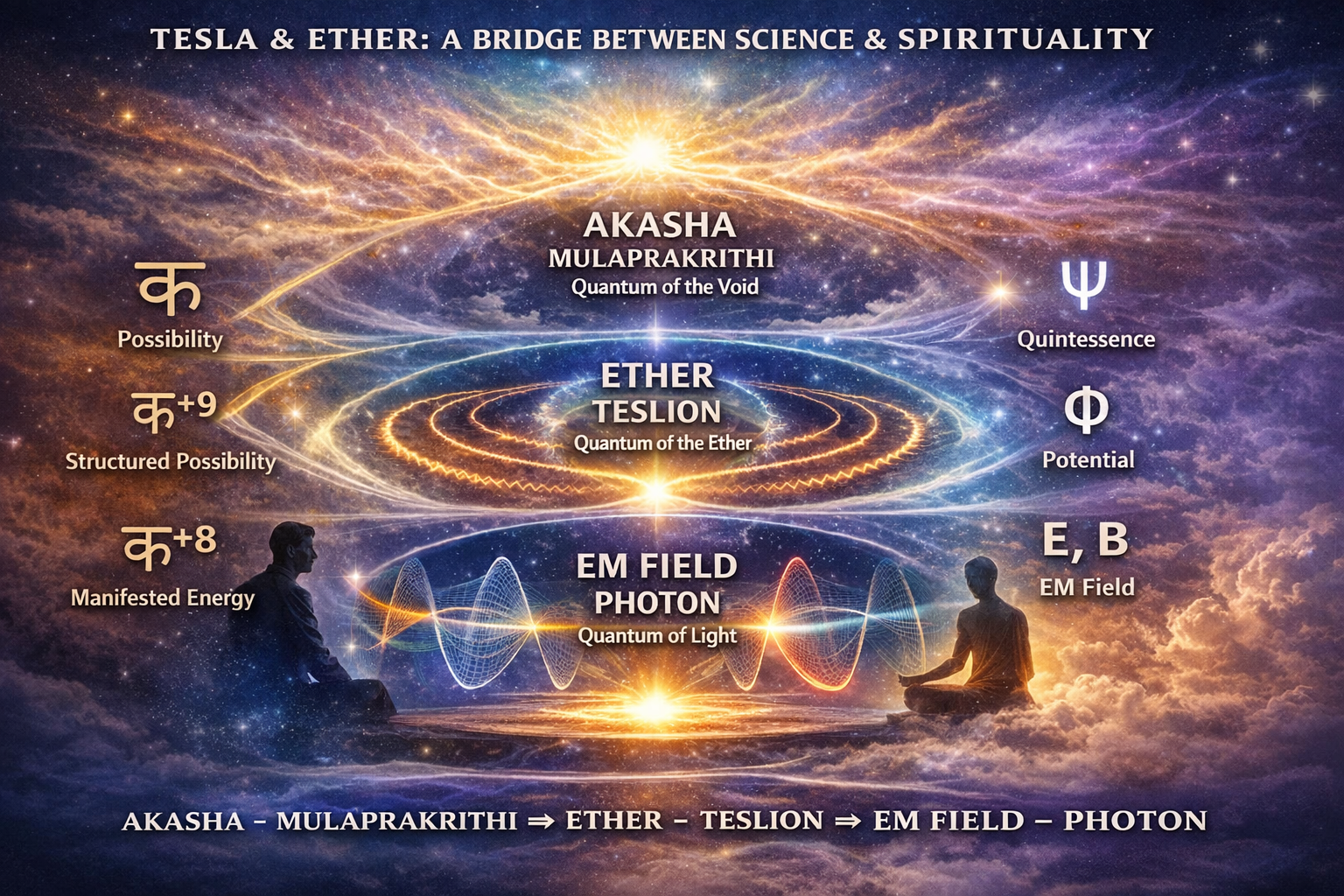
In the text “Akasha – the source of time, space and matter”[1], we presented the elementary matrix of creation which, if formulated into the “Shortest formula of transition” (of the state of the “etheric primal substrate”), would look like this:
Akasha (silence) an infinitely still field, a still “etheric field”, unmanifested potentiality, “the condition of possibility of appearance” – not an active medium, “the possibility of everything =>
=> The appearance of the first difference (the first asymmetry, flicker, change without rhythm; the smallest “flicker” which is not a vibration in space but a difference in symmetry – or – in other words when nothing moves but “something “stands out“, arises =>
Vayu (noise) (difference without memory) first symmetry break, without rhythm =>
=> When a rhythm appears, a rhythm that remembers itself, when the same “blink” is repeated and recognized as the same, a “sequence” arises =>
Kala (tone) = Rhythmic change = Vāyu + self-reference) – there is order but no dynamics yet (“before” and “after” without flow = Eternal Now) =>
=> Repetition of rhythm, a leap from a local difference to a series of differences, a self-sustaining and replicating rhythm; rhythm transmission guided by the internal law of harmony (φ) occurs =>
Time (chord) (time is not movement but an “order of repetition”. Essentially it is a “transformation” of simultaneous into sequential “processes”.) =>
=> when rhythm becomes a cycle (a recurring, periodic process or series of events that return to the same point) – a chord progression = is a progression or harmonic sequence, that is, a series of chords that alternate in melody and harmony, creating a harmonic basis for a song, making it dynamic and emotionally colored. A harmonic sequence (or musical sequence) is the repetition of the same musical motif, or chord sequence, at different pitches, most often shifted by a second (second sequence) or a third, which creates a sense of progression and development), the cycle becomes a relationship – then Prāṇa (musical /harmonic/ sequence) = Expansion (multiplication of instances), or, cycle =>
=> when phase differences appear between cycles that may be simultaneous but different, a phase relationship of a stable rhythm appears, a “here” and “there” with a relational difference appears =>
Space (melody, composition) (network of phase relations of stable rhythm /between prāṇic patterns/) =>
=> when the spiral movement of time loses its freedom and locks into stable vortices =>
Matter (aria – an independent, lyrical vocal composition for a solo voice) a stabilized spiral, a routine of established relationships (a tendency towards an activity acquired through repetition).