Introduction
The foundation of this work consists of ancient Vedic knowledge, which is on the UNESCO World Heritage List as a cultural asset of exceptional significance for humanity.
Vedic scriptures are an immense heritage of civilization, the oldest spiritual records of India and the world, containing the highest knowledge about God and humanity. Specifically: Ayur-Veda → medical and pharmacological writings; Dhanur-Veda → advanced military knowledge; Vymaanika-shastra → detailed technical instructions for constructing flying vehicles (vimanas) with drawings and diagrams; Samsara-sutradhara → descriptions of possible ways of traveling through space, time and various densities; Artha-shastra → predominantly political economy…
For Hindus, the Vedas are spiritual truth that rishis received through meditation directly from God (DEV VANI – God’s voice) and transmitted them orally, from generation to generation.
The immense Vedic heritage was first written down in India over 5000 years ago thanks to the ancient sage – saint Shrila Vyasadeva. Otherwise, the age of the Vedas is considered to be “from the very beginning of the universe,” and they have been on Earth for more than 20 thousand years. Some estimates go up to 33,000 years. It is assumed that when the Aryans moved from their original homeland near the Arctic region to India, they brought with them most of these earlier records (Indus script, Brahmi script…). These were later transferred to Sanskrit – a language created by reorganizing and perfecting the original Vedic language of the Aryans. The word Sanskrit literally means purified or reorganized.
Our problem is that Vedic knowledge uses HOLISTIC images and definitions of compact, complex ideas and principles. Sanskrit has an incredible richness of words and synonyms. Namely, one phenomenon can most often be described with about twenty different words, and each of them has its own fine nuances of meaning. For example, there are more than 70 words for water, the word elephant has an incredible 100 synonyms, and each of them has a specific meaning. Accordingly, despite paying attention to these nuances and richness of expression, a good translation from Sanskrit requires knowledge of Vedic philosophy, the concept of spirituality and the concept of God, cosmos and humanity.
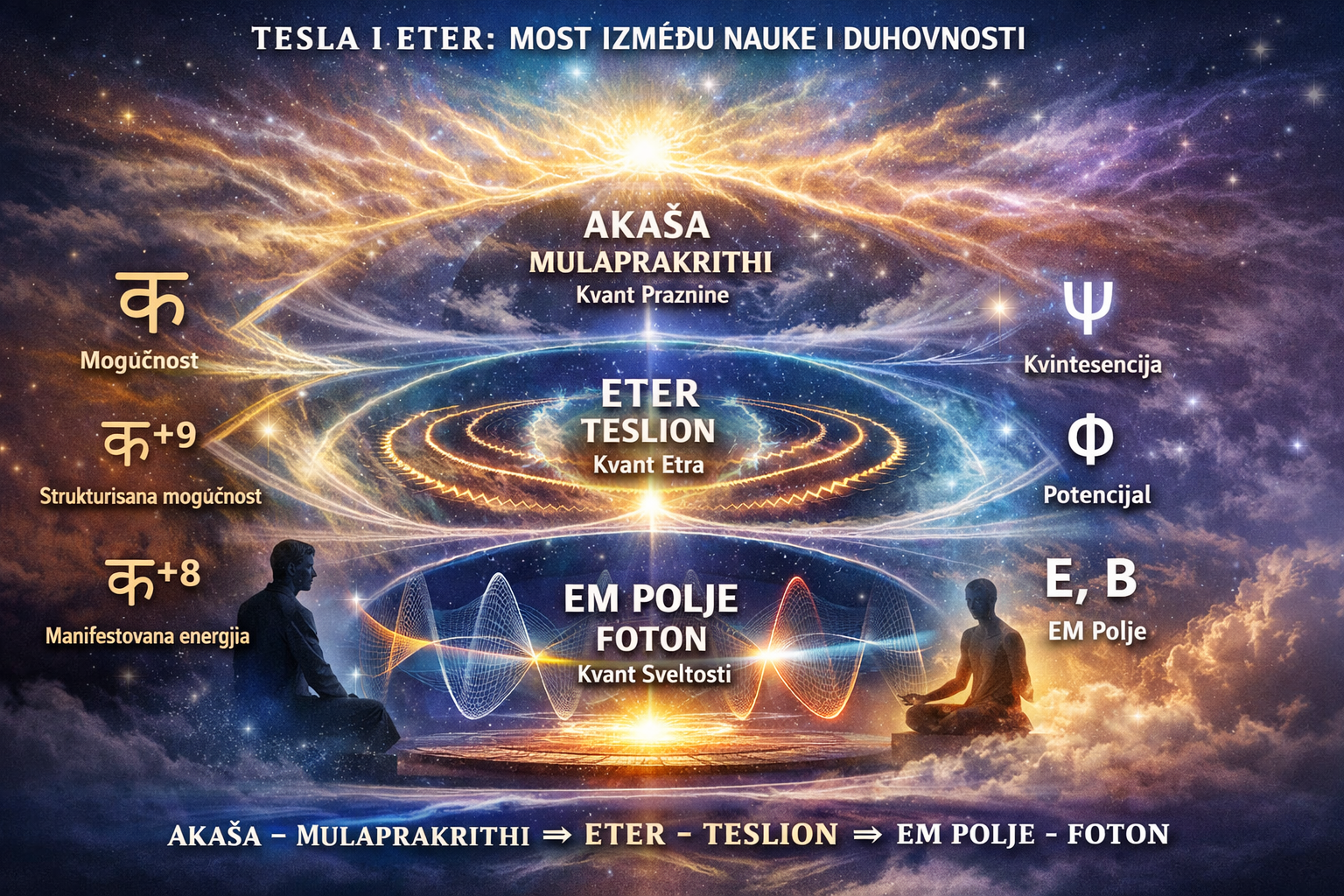
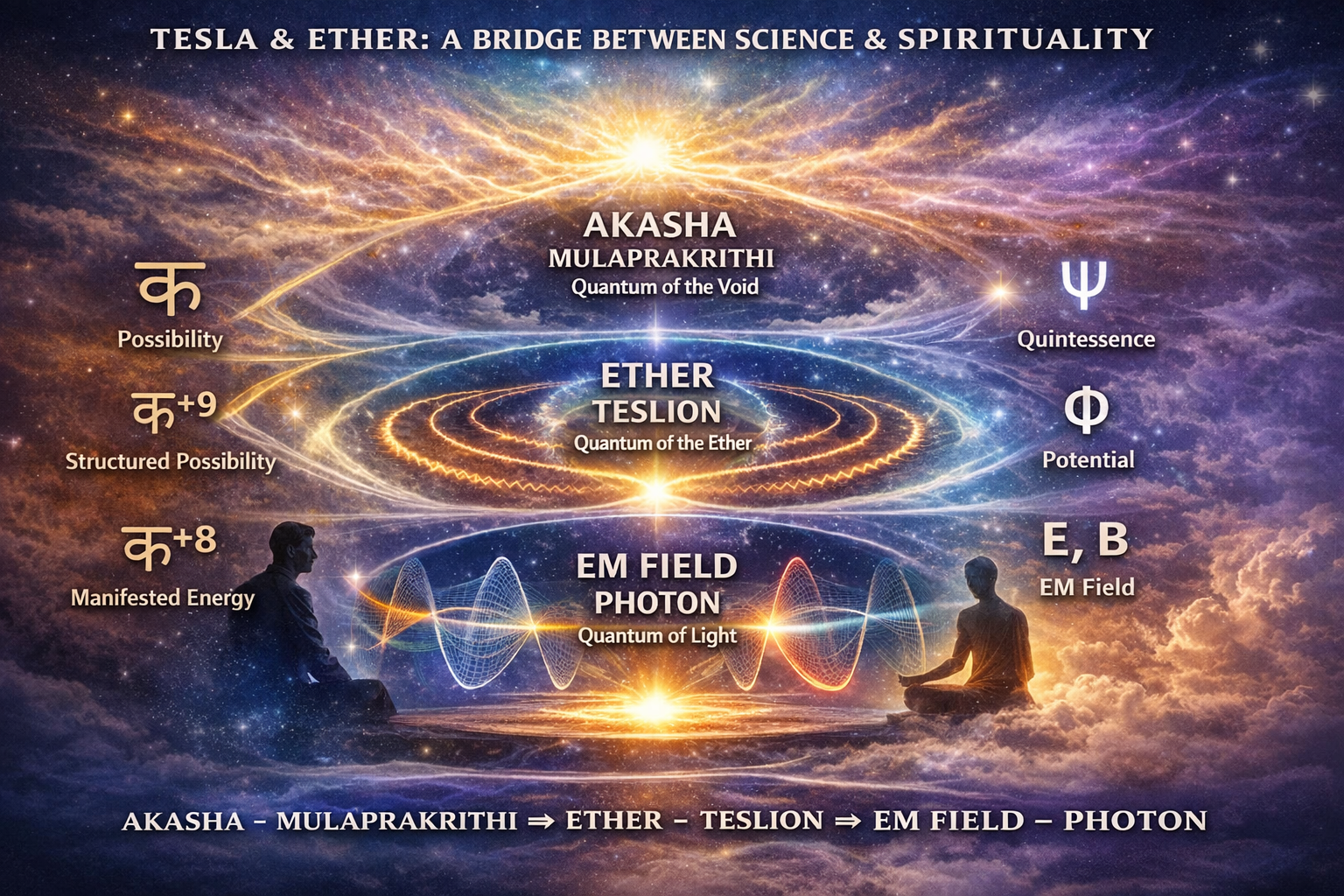
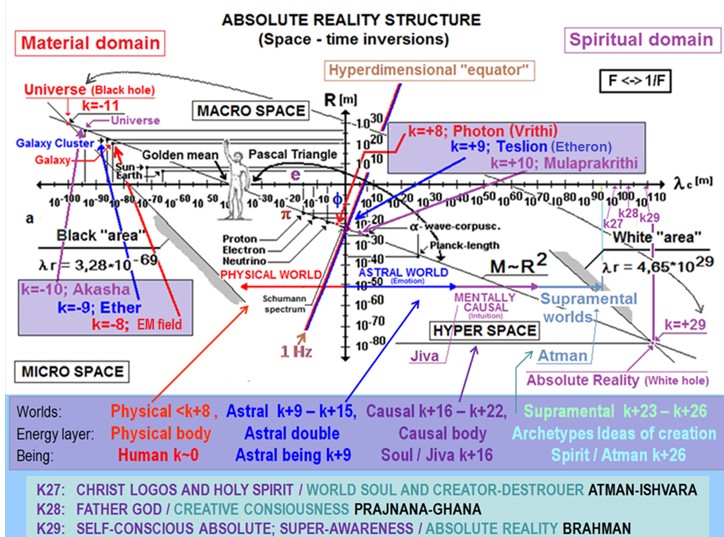
There are also “reverse” problems – when for some term from our or the English language, one needs to find the appropriate word in Sanskrit. For example, the word “Ether” – which is the key word of Tesla’s scalar technologies, only emerged among the ancient Greeks, thousands of years after Sanskrit writings. In such cases, we used various cosmogonic and theosophical teachings with which we tried to “illuminate” these “newer” phenomena with Vedic terminology.
We begin the story about space-time-matter with the Western view of these phenomena – but – we must keep in mind that in Sankhya there are no particles – there are only more or less complex vibrational states. Likewise, according to the Vedas, our sense of the flow of time exists because we have memory where sequential events are stored in consciousness and mind (mind or Citta), which together creates the illusion of time. To good connoisseurs of Vedic teachings, the Western merging of time and space as the fourth dimension of unified space-time may not appeal because, in relation to Vedic knowledge, space and time are phenomena of “different levels” of manifestation.
Establishing correlations with the “latest” scientific theories such as the hypothetical “fifth force,” dark matter and energy is even more demanding in the necessarily required “mental equilibristics” – but – precisely because of this, several different interpretations are an integral part of this work so that through their “approximation and synthesis” we can come as close as possible to agreement with Absolute Reality.