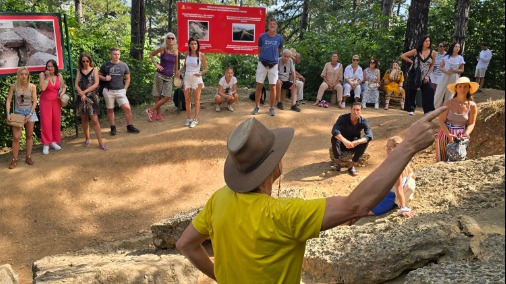
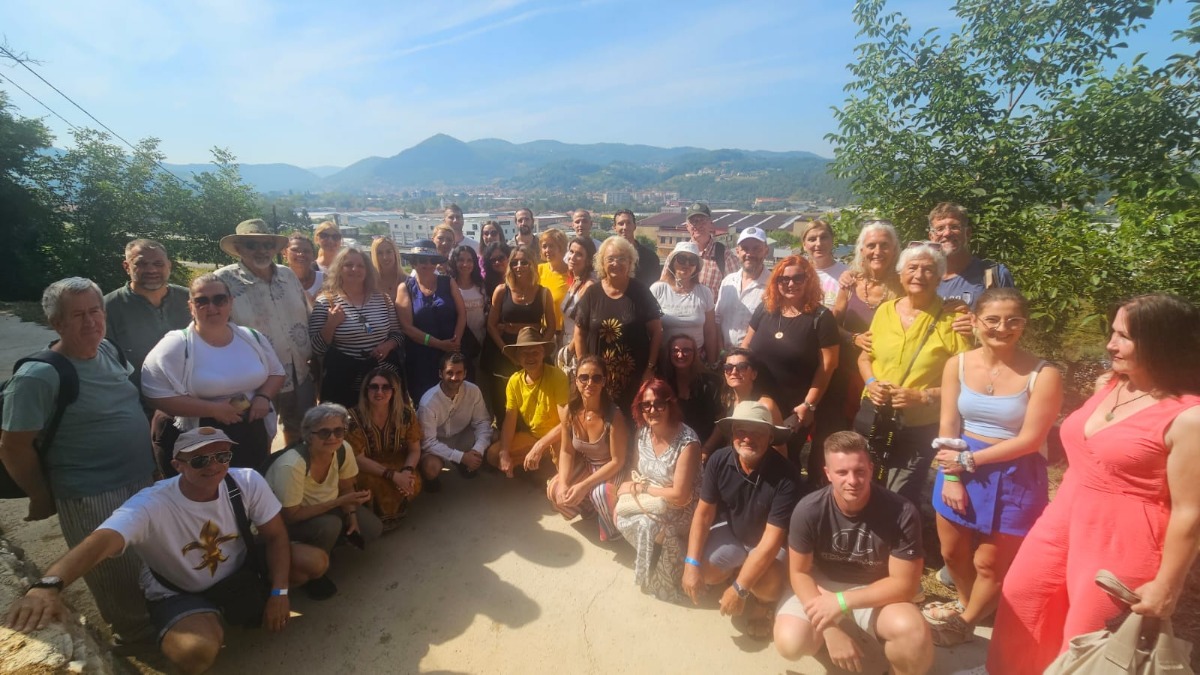
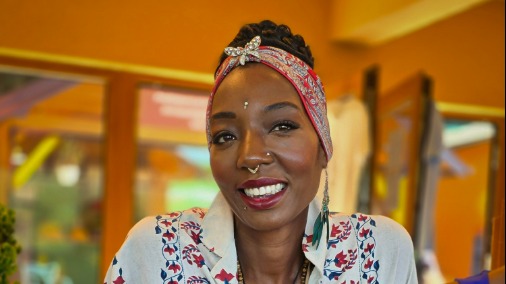
Joachim Reinhold is at the end of his week as a guest of the foundation, a week which produced many insights and fodder for future speculations. He is a senior customs officer in Germany, but was trained in a range of sciences. He was kind enough to give us his impressions of what he saw in his stay.
 Joachim Reinhold is at the end of his week as a guest of the foundation, a week which produced many insights and fodder for future speculations. He is a senior customs officer in Germany, but was trained in a range of sciences. He was kind enough to give us his impressions of what he saw in his stay.
What are your impressions of the project so far?
I think the people are doing a great job. There's definitely something big here, hidden under the hills, and it will take quite a lot of time to explore what is lurking down there. But I do think this will provide a great chance for the Bosnian people to attach themselves to a better vision of life.
I think it's obvious, when you observe everything and try to put the pieces together, you will see that many things here are attached to a more widened view of science.
Can you give me your impressions of the specific sites?
I've been to the Pyramid of the Sun, also the Pyramid of the Moon. Both pyramids stand in their own way. You have different archaeological features, different geological features, they're certainly different in the making, and there must be an explanation why the two pyramids differ so much. Give me your thoughts on the critics of this project.
Let's put it like this: if you have a theory that's not mainstream, you will always get criticized for it. It even happens on a much lower scale than the question of whether we have pyramids here or not. I do think that history was rewritten so often for lesser reasons that the search for the truth is something that people need to question. If you don't question the past you lose your vision for the future… But by ignoring what [nations] had in the past they're not seeing that they might recreate the same problems they had in the past. And in order to avoid falling into the same traps, you really have to know where you have come from, what you have done, good and bad. It's a way of growing up. And I think that the nations of the world are like children who play with what they find. Their playground is history, and they try to put the blocks together into a picture that might fit, or explain why they have so many problems among each other. But this is wrong. You can't mix up history. History is fact, and you have to find out where you really come from, and what really happened in the past.
So you think this project is trying to get at this pure history?
Well, I won't talk about Bosnia, it's a new complex, it hasn't been on the maps for more than 1,000 years. There were people here before, and probably there were people before them. Basically I think the whole project is about the question of what happened in the past, and what can be learned from the past, and perhaps, where we really come from.