


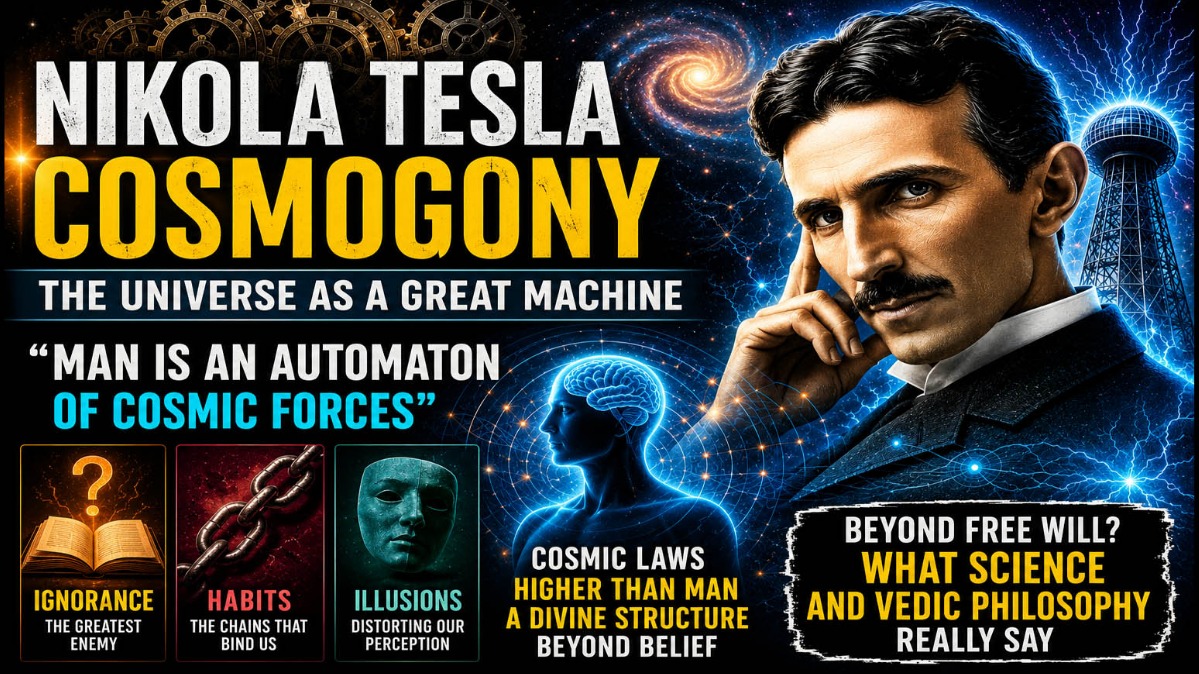
Nikola Tesla never put his cosmogony into a concise form like a book, but it can still be reached by analyzing a series of his published newspaper articles, interviews, and biographical data. When he spoke about the origin and structure of the world, Nikola Tesla often crossed the line between the strict science of his time, natural philosophy, and his own cosmological thoughts. Some of his statements are authentic and well-documented, while others were later wrongly attributed to Tesla. I have highlighted those that have known sources.
The world as a big mechanism
„To me, the universe is simply a great machine which never came into being and never will end. “
Here Tesla takes a very unusual view: he sees the universe not as created by an event in time, but as an eternal process and mechanism that has existed forever.
This statement appears in his writings (often quoted from his article “The Problem of Increasing Human Energy”, published in May 1900, in The Century Magazine), where he discusses his mechanistic conception of the universe.
He believed that the cosmos follows a continuous, law-governed, cause-and-effect loop. It did not “begin” in the traditional creationist sense – according to which all the living world, the Earth and the entire cosmos came into being by direct divine creation and not by natural processes such as evolution – and it will not “end” with destruction, but rather develops endlessly through mutual transformations of energy and matter.
Tesla applied this same logic to human beings. He saw our thoughts and actions as direct responses to external stimuli. With his statement:
“Man is an automaton of cosmic forces”
which is found in his autobiographical essay “How Cosmic Forces Shape Human Destinies”, published on February 7, 1915 in the American newspaper New Yorker American, Tesla described man as a mechanical being without free will. He believed that all our actions, thoughts and memories are actually automatic reactions and reflexes caused by external influences and invisible forces from the universe. His key thoughts behind this claim include the following:
Man as a receiver: Tesla viewed the human brain as a receiving device, not as an independent source of consciousness. He believed that the universe sends us ideas, inspiration, and knowledge that we simply “catch” and put into action.
External stimuli: He argued that our decisions are controlled by our environment. Man reacts to physical laws, atmospheric pressure, light, sounds, and other electrical or energetic vibrations in nature.
The fallacy of free will: According to Tesla, our thoughts and actions are merely mechanical responses to external environmental and cosmic stimuli. We mistakenly consider the resulting impulses to be conscious choices, living under the illusion of autonomy.
This philosophical thought connects his engineering genius with spirituality, as he saw the entire cosmos as a perfect machine governed by the laws of physics and energy. Denying human free will sounds very controversial. However, modern science also speaks in Tesla’s favor.
In his book “The Immortal Mind: A Neurosurgeon’s Argument for the Existence of the Soul,” Dr. Michael Egnor, a neurosurgeon who has performed over 7,000 brain surgeries, tells us after decades of research:
Quote: “The brain is the organ of movement, perception, memory and emotion. There is no organ of intellect and will.”
The brain is an organ just like any other organ. The heart has a function – it pumps blood. The kidneys have a function – they produce urine. Each organ does its own thing. The brain is also an organ that keeps blood pressure normal, keeps the heart rate normal, and so on. It allows us to move, to have sensations, to have memories, and to have emotions.
But neuroscience makes it clear that intellect, the ability to reason, to think abstractly, and to free will, do not come from the brain. They do not come from any flesh. They do not come from organs. They are powers of our soul. But these powers of our soul are immaterial. And because they are immaterial, they are spiritual.
We have spiritual souls. And because they are immaterial, they cannot die. That is, things that are not matter cannot disintegrate at the moment of death. So that points to the immortality of our souls, which I think has also been proven by neuroscience. End quote.
It is very interesting that Tesla almost never mentions God and the soul, even though he came from a deeply religious family, as his father was an Orthodox priest and his mother’s seven brothers all were also priests. A possible reason is the fact that Tesla favored a scientific order based on theoretical and experimental foundations over dogmatic religion. However, he often emphasized that the essential laws of physics of the universe are a higher, almost divine structure.
This unusual statement by Tesla, which does not agree with generally accepted opinions, is nevertheless in line with Vedic philosophy, where the “Concept of 5 koshas” or Pancha kosha (five layers of consciousness) describes human existence from the grossest (Annamaya kosha – physical body) to the most subtle[1] (Anandamaya kosha – body of bliss). Free will is a dynamic ability located in the 4th, Vijnanamaya kosha (sheath of intellect and wisdom). This is the place of true free will (so-called Purushartha) from where the lower sheaths are controlled, with our physical body being the most primitive form of our Real Being – “the home of instincts and passions”, determined by genetics, environment and past actions. There is no free will here, but inertia acts… So the wise Tesla tells us the same thing that the ancients and modern neuro-scientists knew.
In the text: “The Greatest Achievement of Man” originally published on July 6, 1930 in the American newspaper New York Times, Tesla explains how a human being absorbs the influences of the outside world from birth, and describes three basic ways in which a person can achieve his greatest achievements by increasing human energy through the fight against the forces that slow him down:
1 – Reducing resistance forces (forces of friction, deceleration): Tesla identified three main forces that act as brakes for humanity:
Lack of knowledge: He considered it the greatest force of friction that slows down human progress and creates misunderstanding.
Stupidity (Unreasonableness): Behaviors and actions that directly consume human energy without any creative outcome.
Religious and other fanaticism: Forces that cause conflict, intolerance, and drain the energy of the masses instead of directing it towards progress.
Solution: The reduction of these retarding forces is achieved by the spread of education, the development of science and the pursuit of general peace and harmony.
2 – Increasing the motional force – in order to increase energy, the motional force that moves humanity (the force of forward movement) must be increased through the invention and mastery of natural forces, especially inexhaustible sources like solar energy, wind and oceans.
3 – Increasing “human mass” – Mass in Tesla’s physical model of humanity represents the total number of people, their well-being, health and living conditions. Mass increase is achieved by increasing food sources and improving living conditions, which encourages the growth and health of the population.
One of Tesla’s most unusual statements comes from an interview on February 9, 1915, titled “The Nature and Purpose of Life,” which was published in Collier’s Weekly:
„ My brain is only a receiver, in the Universe there is a core from which we obtain knowledge, strength and inspiration. I have not penetrated into the secrets of this core, but I know that it exists.“
This famous quote encapsulates Tesla’s belief that human creativity and genius are not generated internally, but are “received” from a universal source. Tesla’s visionary take on this idea highlights several fascinating concepts:
– Discovery above invention: He saw inventors not as creators, but as channels or instruments attuned to deeper, pre-existing universal principles.
– Universal Core: He believed that all ideas, innovations, and energy emanated from a vast, invisible “core” or source of knowledge.
– The power of solitude: Tesla emphasized that originality advances in absolute solitude, free from the distracting noise of the outside world, which allowed him to better “tune in” to his ideas.
Matter arises from the subtle medium
In the text “The greatest achievement of man” he wrote:
„ All visible matter originates from the primordial substance that fills all space …“
Tesla explains that this original substance ether (akasha) is transformed into matter under the influence of the creative force, and when the movement stops, the matter returns to its original state. It is one of Tesla’s clearest descriptions of the origin of matter.
Exploring deep philosophical and physical parallels between his concept of the universe and ancient Eastern metaphysics, Tesla described how the physical universe operates on a continuous, cyclical loop of mutual transformations of matter and energy:
„All perceptible matter comes from a primary substance, or tenuity beyond conception, filling all space, the akasha or luminiferous ether, which is acted upon by the life giving Prana or creative force, calling into existence, in never-ending cycles all things and phenomena.“
Tesla believed that space is never truly empty. Instead, it is filled with a special fluid-like medium called ether or Akasha (a Sanskrit term he adopted).
It is interesting here that Tesla uses concepts from Indian philosophy (Akasha and Prana) to describe the origin of matter and phenomena in the universe. It was not part of the official physics of the time, but his attempt to connect science and ancient cosmological ideas.
This famous passage reveals Tesla’s synthesis of ancient Eastern philosophy and 19th century physics. He believed that all matter originates from a primary, formless medium – Akasha or luminiferous ether.
Aether – In 19th century physics, scientists postulated the “luminiferous aether” as an invisible, omnipresent medium through which light and electromagnetic waves travel. Tesla believed that this ether is the ultimate universal medium – a fluid – with very “special properties” that behaves like a solid body towards light (high frequency) and heat, is transparent to matter and its effects can be felt through inertia.[2]
We must emphasize that the ether was the BASIC CONCEPT OF ALL SCIENTIFIC THEORIES until the beginning of the 20th century – from Newton’s theory of gravity through Bernoulli’s corpuscular and Huygens’ wave theories of light up to modern theorists such as Paul Dirac and John Bell[3] …
Akasha is an ancient Vedic term for the basis of all physical matter.
Prana is the Creative Force, the primary life force or energy. In Tesla’s dynamic framework, this is a force or vibration that acts on the inert ether.
Creation of Matter: He believed that when this primary substance – the ether – is subjected to a mechanical force and begins to move in the form of tiny, microscopic, ultrafast whirls (or “vortexes”), it condenses into the physical matter that we perceive. When this primary force weakens and the vortex motion ceases, matter decomposes again and returns to the state of invisible ether.
While mainstream physics abandoned the concept of the ether after the Michelson-Morley experiments and the rise of quantum mechanics, Tesla continued to develop a mechanical and electromagnetic explanation of the universe. He viewed the universe not as the product of curved space-time as defined by Einstein’s Theory of Relativity but as the interaction between dynamic, infinite energy and the etheric fluid. He believed that space could not be curved per se and that the idea of converting mass into energy was incorrect, since mass itself was a form of energy.
These ideas show Tesla not only as an electrical engineer, but also as a visionary who thought about the quantum nature of reality and a unified field of energy decades before such theories became part of modern physics.
Nature as an infinite energy system
Tesla believed that everything in the universe moves and vibrates, which is summarized in his famous statement:
„ If you want to discover the secrets of the universe, think in terms of energy, frequency, and vibration.“
Although this statement is often mentioned, there is no reliable original source for it, so it should be taken with a grain of salt, but it certainly synthesizes Tesla’s specific perspective, which reflects his fascination with Vedic philosophy, which he studied carefully after being introduced to it by the Indian monk Swami Vivekananda.
Nikola Tesla – Vivekananda
The meeting between Nikola Tesla and Swami Vivekananda in the 1890s led to a fascinating fusion of Eastern philosophy and Western science.
There are stories that Tesla and Vivekananda first met in Chicago at the Columbian Exposition of 1893 because they were both there at the same time – Tesla – to work with Westinghouse to light the exhibition and Vivekananda at the World Congress of Religions. However, there is no valid evidence of this. What is indisputable and well documented is that they met at a reception at the home of the famous actress Sarah Bernhardt, which she organized after the premiere of the play Iziel (The Story of the Life of the Buddha) in which she played the leading role.
Vivekananda introduced Tesla to the Vedic concepts of prana – universal life energy, which is the motional principle or motional force, and akasha as a form of earlier-matter (precursor or primordial cause of matter). Tesla believed that force and matter could be reduced to potential energy and tried to prove it mathematically. He wanted to prove that matter is just condensed energy in the ether.
In late 1895, Vivekananda described Tesla’s intention in a letter to his friend and spoke with great enthusiasm about the proof that would unite Vedic cosmology with Western science. Tesla was fascinated by the Vedic teachings that helped him describe the mechanisms of the universe. This historic meeting between the scientist and the Indian philosopher beautifully illustrates Tesla’s desire to combine spirituality and exact physics.
Although Tesla failed in his intention, similar ideas were mathematically confirmed just a few years later through Einstein’s theory of relativity and the equation E=mc^2.
On the ether as the basis of reality
Yet Tesla’s insights into the structure of reality are extremely profound. In his 1900 article, “The Problem of Increasing Human Energy,” published in The Century Magazine, he said:
„ The eternal receiver and transmitter of this infinite energy is the ether.“
It should be noted that Tesla remained committed to the concept of ether even after modern physics took a different path.
Speaking of nature, Tesla says:
„ Nature has stored infinite energy in the universe.”
These words testify to his belief that the universe is a storehouse of infinite energy, and that – by using the “ether” – we can tap into this universal, inexhaustible source of energy.
While the scientific community has moved beyond the ether theory in favor of modern physics, Tesla’s visionary ideas about renewable energy and cosmic power continue to fascinate researchers around the world.
Continuing the previous quote, Tesla says:
“Throughout space there is energy…then it is a mere question of time when men will succeed in attaching their machinery to the very wheelwork of nature.”
Tesla believed that humanity would find a way to directly use free energy from the environment instead of consuming limited resources, a claim he made while explaining his visions of the so-called “energy from the ether.” He spoke of nature offering inexhaustible sources of energy all around us and that it was only a matter of time before we learned to synchronize our machines with these natural rhythms.
It is more than interesting that Gopala Srinivansan in his book “Secrets of Sankhya”[4], which discusses ancient Vedic knowledge, cites “Sutra 37” which talks about “Extraction of potential energy from the Purusha domain”:
Potential energy can be extracted from the “within” hidden interior of the Purusha region by repeatedly activating (so-called triggering) the primary interactive region (“core of core”) with extremely short, sharp, triggering pulses of input energy. The mathematical formulation is derived in the last few Sutras. The eternal (permanent) oscillatory state can be disturbed by an activating pulse which then releases a large amount of energy during the process of restoring its harmonic oscillatory state.
It is more than interesting that modern science also points to enormous amounts of energy “hidden” in the vacuum. Based on the value of Planck’s constant and the upper limit of the cosmological constant, according to quantum electrodynamics, consistency with the Lorentz covariance principle requires that the zero-point energy has a value greater than 10^113 joules per cubic meter!!! This truly enormous and completely incomprehensible value to us (a unit with one hundred and thirteen zeros!?) is known in science as the „Vacuum catastrophe“.[5]
Balance of forces at infinity
Tesla emphasized that there is a deep harmony in nature, and one of his basic philosophical ideas is that the universe is not chaotic but rather ordered through a balance of energies and forces.
This profound concept was expressed by Nikola Tesla in his 1915 article “The Wonderful World That Electricity Will Create” for the magazine “Electrical Experimenter”, where he described the beautiful connection between cosmic harmony and the human mind:
„According to the law of conservation of energy, throughout the Infinite, forces are in perfect balance and therefore: the energy of a single thought can determine the movement of the universe.“
This quote reflects his belief in an interconnected universe where energy is conserved and even the smallest actions – like a fleeting thought or a single ray of light – can spread and cause monumental changes.
On the other hand, as early as 1900, in his philosophical-scientific essay “The Problem of Increasing Human Energy”, published in “Century Magazine”, he wrote about how a single pulse of energy from a distant star – could affect the fate of humanity and change the universe:
„A single ray of light from a distant star falling upon the eye of a tyrant in bygone times may have altered the course of his life, may have changed the destiny of nations, may have transformed the surface of the globe…“
This quote draws on his fascination with the law of conservation of energy and how every phenomenon in nature, no matter how small, is connected into an infinitely complex process.
Tesla’s statements analogous to the ideas of Vedanta, Sankhya, and Eastern cosmology
At certain periods of his life, Tesla used concepts like Akasha and Prana in very interesting ways. He was one of the few great Western scientists of his time who openly showed interest in Indian philosophy.
It is known that at the end of the 19th century he met Swami Vivekananda, a direct disciple of Sri Ramakrishna, a Hindu monk and one of the most famous representatives of Indian philosophy and Vedanta in the West, who introduced Tesla to the basics of Vedic knowledge, according to which:
– Akasha is the finest element, the universal “space” or primordial substrate of all,
– Prana is the universal life energy or motional principle,
so Tesla writes: “Akasha or light-bearing ether, which is acted upon by Prana or creative force…”
which is analogous to the Vedic interpretation according to which: Akasha + Prana → build → the manifested universe.
In other words, the material world is created when movement, vibrations and forms appear on the original basis through the action of energy.
Matter is not the fundamental reality.
One of Tesla’s most interesting ideas is that matter is not the ultimate reality. He considered that:
– energy is more fundamental than matter,
– the space is filled with an active medium,
– matter is only a transitory state of that medium.
This is very reminiscent of the Vedantic idea that the visible world is a transitory manifestation of a deeper reality.
Cosmos as unity
Vedanta says that behind the multiplicity of phenomena there is a single basis — Brahman. Tesla did not use this term, but he often spoke about the unity of nature, the connection of all phenomena, universal harmony and balance of forces.
His view of the world was much closer to an organic and unique cosmos than to the mechanical universe that is often attributed to the science of the 19th century.
How does Tesla differ from Vedanta ?
There is an important difference here.
In classical Advaita Vedanta:
– consciousness (Atman/Brahman) is the ultimate reality,
– matter and energy are secondary manifestations.
At Tesla:
– in the center of attention are energy, force and ether,
he did not elaborate consciousness as the basic principle of the universe.
Therefore, one could say that Tesla was closer to an energy cosmology, while Vedanta starts from consciousness, which is the foundation of everything.
Conclusion:
It is interesting that some researchers believe that Tesla, when he talks about Akash, Prana and the creative force, was actually standing on a kind of bridge between the science of the 19th century, Vedantic metaphysics and his own intuition about the universe. He did not become a follower of Vedanta in the philosophical sense, but he was certainly one of the few scientists who seriously considered the possibility that ancient cosmologies preserved important insights into the organization of the world.
It is also interesting that some of Tesla’s descriptions of the “creative force” are sometimes closer to the term Fohat from theosophical literature than to the classic mechanical force.
In theosophy, Fohat is a transcendent cosmic energy, that is, a versatile force that acts as a link between spirit (Divine Thought) and matter. It is the primary creative impulse that shapes the cosmos, bringing ideas from the universal mind into concrete physical manifestation.
The basic characteristics of Fohat include:
Universal life and movement: Represents the vital force of nature that moves all atoms, stars and worlds. It is considered the “cosmic electricity” that animates the universe.
Shape Builder: Acts as the “architect” of the universe. Fohat is the instrument by which the Logos (Divine Principle) works to create the world out of chaos, a bridge between the invisible, metaphysical, and the visible, physical world. He unifies and guides the cosmic laws.
In the context of Hindu cosmology, Fohat can be identified with Shakti, more precisely with Chit-Shakti – the power of pure consciousness, because both phenomena represent a conscious force that translates a spiritual impulse into a physical manifestation.
It must be admitted that among the most interesting are exactly these topics – when Tesla, the philosophy of nature, Vedanta, physics and the question of what is actually the basis of reality meet.
What is particularly interesting about Tesla is that he was neither a classical mystic nor a classical materialist. While many scientists of his time viewed the world as a set of solid particles moving in empty space, Tesla often spoke of energy, continuum, ether, vibrations and the universal connection of phenomena. Because of this, it is difficult to classify it in the usual categories.
When his ideas are compared with Vedanta, an interesting series of analogies is observed:
• Akasha ↔ universal substrate of space,
• Prana ↔ cosmic energy or motional principle,
• manifested world ↔ matter and force,
• cyclical transformation: Prakrti – Purusha ↔ birth and return of matter to its original state.
However, a big difference remains: Vedanta ends up with consciousness as the basis of everything, while Tesla mainly talks about the energy and dynamics of nature.
It is interesting that the phenomenon of Fohat could be connected to exactly this difference. In some esoteric systems, Fohat is an intermediary between consciousness and energy – something that “transmits” an idea into manifestation. That is why a certain interconnection between Vedantic prana, theosophical Fohat, Hindu Shakti and Tesla’s “creative force” that acts on the ether to build matter is evident.
Of course, these are not identical concepts, but they revolve around the same great philosophical theme: how from a unique, unmanifested source, a multitude of forms and phenomena arise that we perceive as the material world.
And that is a question that equally preoccupied the ancient rishis, Tesla, and modern physicists. Throughout history, people observed the same sky, the same stars and the same natural phenomena, and yet they described them in different languages - the language of mathematics, religion, philosophy or mysticism. What is fascinating is that sometimes behind these different expressions the same question can be seen:
What is it that everything emanate from and that connects everything ?
Tesla approached this question as a researcher of nature, the rishis of India as researchers of consciousness, and modern physics through the research of fields, energy and space-time. Each approach illuminates a part of that big puzzle.
Perhaps this is precisely why Tesla is still so attractive to people with different views on the world – he was rigorous enough to remain a scientist, and open enough not to reject the possibility that reality has deeper, more subtle layers than those we currently understand and describe with existing scientific theories.
If I were to single out one thought that constantly runs through many of his thoughts, it is the deep conviction that nature is comprehensible and that behind apparent chaos there is order. Whether we call it the laws of nature, cosmic intelligence or divine order, Tesla spent his entire life trying to discover that order and translate it into practical actions for the benefit and well-being of mankind.
In Belgrade, 08.06.26.
Goran Marjanović, BSc
